GEO: how your business gets recommended by ChatGPT, Gemini and Perplexity
Contents
- What is GEO and how is it different from SEO?
- Do AI assistants matter for a small business?
- How do ChatGPT, Gemini and Perplexity read your site?
- What did we do on navitech.systems?
- What can you do on your own site, step by step?
- What doesn't work, or isn't necessary?
- Frequently asked questions
- Want a site AI assistants can read and quote?
- Sources
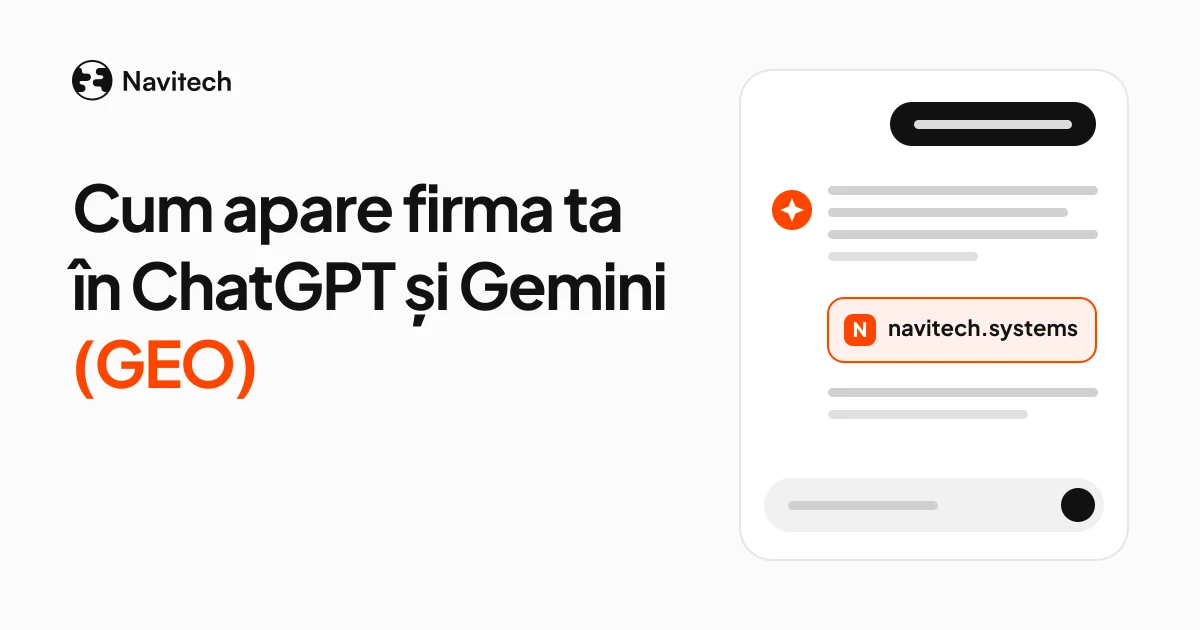
How do you show up in ChatGPT? There's no sign-up form and no secret setting. AI assistants that search the web read your site with their own bots, and Google says explicitly that AI Overviews need no special optimization, just a page that's indexed and eligible for a snippet (Google Search Central). You have three jobs: let the bots in, write clear answers an AI can quote, and say the same things about your business everywhere it appears.
The market calls this work GEO (generative engine optimization). This article covers what it means in practice, which bots matter, what we did on our own site and what isn't worth paying for.
What is GEO and how is it different from SEO?
SEO helps you appear in Google's list of links. GEO helps you get quoted or recommended in the answer an AI assistant writes. The foundations are the same, but the result looks different:
| Classic SEO | GEO | |
|---|---|---|
| Where you appear | in Google's results list | in the answer written by ChatGPT, Gemini, Perplexity or AI Overviews |
| What the user gets | 10 links, picks one | a ready-made answer with a few cited sources |
| What matters most | page relevance, links, speed | the same, plus direct answers that are easy to extract and quote |
| Who reads your site | Googlebot, Bingbot | Googlebot, plus AI bots: OAI-SearchBot, PerplexityBot and others |
| How you measure it | rankings, clicks in Search Console | mentions and citations in answers, hard to measure for now |
GEO isn't a separate discipline from SEO. It's SEO done well, for a reader who wants the answer, not ten links.
Do AI assistants matter for a small business?
Yes, even if your clients never open ChatGPT. Across the EU, 32.7% of people aged 16–74 used generative AI tools in 2025, according to Eurostat (Eurostat).
The bigger effect is the one you feel inside Google itself: AI summaries. A Pew Research study of 900 US adults found that when an AI summary appears, people click a classic result on 8% of visits, versus 15% when there's no summary. They click the links cited in the summary itself on only 1% of visits (Pew Research Center).
So when an AI summary appears, clicks drop for everyone, cited sources included. Being cited still matters for visibility, even when it doesn't bring many clicks.
How do ChatGPT, Gemini and Perplexity read your site?
Each assistant has several bots, each with a different job. The search bots are the ones you need to allow in robots.txt:
| Bot | Owner | What it does | If you block it |
|---|---|---|---|
| OAI-SearchBot | OpenAI | indexes sites for ChatGPT search | you no longer appear in ChatGPT search answers (you may still show up as a plain link) |
| GPTBot | OpenAI | collects content for model training | your content isn't used for training; search visibility isn't affected |
| ChatGPT-User | OpenAI | visits a page when a user asks for it | doesn't affect search visibility; as a user action, it may not follow robots.txt |
| PerplexityBot | Perplexity | surfaces and links sites in Perplexity results | Perplexity recommends allowing it so you appear in results |
| Googlebot | regular indexing, also used by AI Overviews and AI Mode | you disappear from Google and from AI Overviews |
Sources: OpenAI, Perplexity, Google.
You can block training (GPTBot) without disappearing from ChatGPT search (OAI-SearchBot). Block every AI bot "just to be safe" and you vanish from search answers too.
What did we do on navitech.systems?
We've applied some of the steps below on navitech.systems, and you can check the result live:
- No bot is blocked. Our
robots.txthasAllow: /for everyone and points to the sitemap. - We published an
llms.txtwith our services, starting prices, company details, projects and articles. It's a Markdown summary an AI agent can read in seconds. - We added structured data (JSON-LD). On the homepage:
Organization,WebSiteand aServicefor each package, with its starting price. On articles:BlogPosting, with a real person as author, andBreadcrumbList. - The answer comes first. Our articles, like WordPress vs custom website, open with the answer and the figures, with a source next to each one.
- The same numbers everywhere. Our pages used to give different figures for clients and projects. Now every page says 60+, so an AI doesn't find contradictory data about us.
We don't have separate service pages or an About page yet; we're working on them. We're not promising results. The changes are recent and we don't have before-and-after data yet. When we do, we'll publish it here.
What can you do on your own site, step by step?
- Check
robots.txt. Look forDisallowrules for OAI-SearchBot, PerplexityBot or Googlebot. If you want to block training, block only GPTBot. - Check indexing in Google Search Console. If a page isn't indexed, it won't appear in AI Overviews either (Google).
- Put the answer in the first 2–3 sentences of every important page. An AI quotes a clear sentence more easily than an introductory paragraph.
- Write concrete prices, timelines and figures. "From €1,000, in 4 weeks" gets quoted. "Competitive prices" doesn't.
- Create one page per service, not one long homepage with everything on it.
- Show who's behind the business: an About page, real authors on articles, full contact details.
- Add structured data that describes what's on the page. Google requires markup to be a faithful representation of the content and doesn't guarantee it will be displayed (Google).
- Test it. Ask ChatGPT, Gemini and Perplexity what they'd recommend in your niche and your city. Note who shows up and which sources they cite.
What doesn't work, or isn't necessary?
The "magic file". llms.txt is a 2024 proposal, not an official standard (llmstxt.org). Google says you don't need new AI files to appear in AI Overviews (Google). We added one because it's quick and does no harm, but we don't expect much from it.
Special AI schema. There isn't any. Google says explicitly that AI features need no special structured data (Google). Structured data helps machines understand a page; it doesn't unlock anything.
Text written for robots. Google treats keyword stuffing as spam (Google), and pages full of questions without real answers have nothing to offer an assistant. Assistants look for sentences that actually answer.
Guarantees of "ranking in ChatGPT". Nobody controls what a model answers. Anyone who guarantees you the top spot in ChatGPT is selling a promise, not a service.
Frequently asked questions
How do I get my business to show up in ChatGPT?
Let OAI-SearchBot access your site, make sure your important pages answer your clients' questions clearly, and keep your company details identical everywhere. Blocking OAI-SearchBot removes you from ChatGPT search answers (OpenAI).
Do I need to do anything special for Google AI Overviews?
No. Google says there are no extra requirements: the page just has to be indexed and eligible to appear with a snippet in Google Search (Google).
If I block GPTBot, will I disappear from ChatGPT?
No. GPTBot collects content for model training. For ChatGPT search, OAI-SearchBot is the one that counts (OpenAI).
Do I need an llms.txt file?
It's not required. It's a proposal, not a standard (llmstxt.org), and Google doesn't ask for it. It can help AI agents understand your site quickly, and it costs little to make.
How long until I appear in AI answers?
There's no guaranteed timeline. OpenAI and Perplexity say a change to robots.txt is picked up in about 24 hours (OpenAI, Perplexity), but that only means the bots have access, not that you'll be cited.
Does GEO replace SEO?
No. AI Overviews draw on Google's index, and assistants cite well-built pages. Without clean technical SEO, GEO has nothing to stand on.
Want a site AI assistants can read and quote?
Tell us what site you have and what you want to achieve. We'll reply with a clear quote.
You can see our projects in the Navitech portfolio.
Sources
- Google Search Central, AI features and your website (updated 10 December 2025): https://developers.google.com/search/docs/appearance/ai-features
- Google Search Central, General structured data guidelines: https://developers.google.com/search/docs/appearance/structured-data/sd-policies
- OpenAI, Overview of OpenAI Crawlers: https://developers.openai.com/api/docs/bots
- Perplexity, Perplexity Crawlers: https://docs.perplexity.ai/guides/bots
- Eurostat (16 December 2025), 32.7% of EU people used generative AI tools in 2025: https://ec.europa.eu/eurostat/web/products-eurostat-news/w/ddn-20251216-3
- Pew Research Center (22 July 2025), Google users are less likely to click on links when an AI summary appears: https://www.pewresearch.org/short-reads/2025/07/22/google-users-are-less-likely-to-click-on-links-when-an-ai-summary-appears-in-the-results/
- Google Search Central, Spam policies for Google web search: https://developers.google.com/search/docs/essentials/spam-policies
- llmstxt.org, The /llms.txt file: https://llmstxt.org/
- Navitech,
robots.txtandllms.txt: https://navitech.systems/robots.txt, https://navitech.systems/llms.txt
Daniel-Ionuț Grigoraș